COMMANDER WILLIAM HENRY NORMAN
[Grave inscription on p. 8]
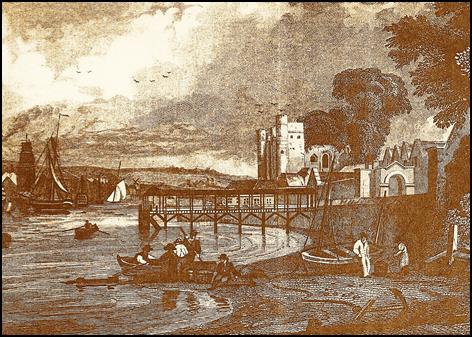
Upnor Castle near Chatham in 1830
When William Henry Norman was born at Upnor, Kent, just across the River
Medway from Chatham on March 3rd 1812, his
father Thomas was a shipwright, and was then 41 years of age. His mother Sarah was 42. William Henry was baptised at Frindsbury on
April 12th in the same church as his younger sister Esther on 30th
August 1814. At the age of 15 years in
January 1828 William was apprenticed into the Merchant Marines. He was bound for 5 years to Thomas Hall, and
so began his 45 years at sea.
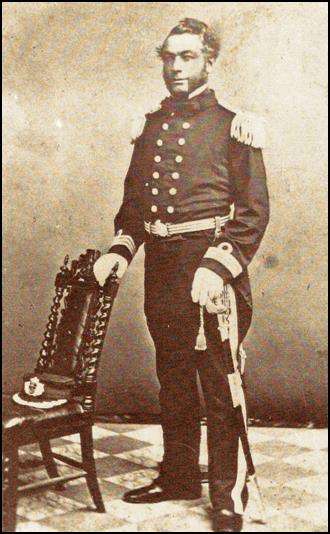 Captain Norman's
life-story is eminently that "of a man of action and his acknowledged
stores of professional knowledge were gained by some of the hardest work a man
can be called upon to undergo."[1] He soon became a Master Mariner. In 1834 he married Sarah Stretch of Hackney and their son William Thomas Norman was born in
London in 1839.Captain Norman's mother Sarah died in January 1835, aged 63
years and was buried at All Saints Frindsbury on January 6th 1836
(p.124 of the register, entry No: 985).
Captain Norman's
life-story is eminently that "of a man of action and his acknowledged
stores of professional knowledge were gained by some of the hardest work a man
can be called upon to undergo."[1] He soon became a Master Mariner. In 1834 he married Sarah Stretch of Hackney and their son William Thomas Norman was born in
London in 1839.Captain Norman's mother Sarah died in January 1835, aged 63
years and was buried at All Saints Frindsbury on January 6th 1836
(p.124 of the register, entry No: 985).
One of William Henry
Norman's early appointments in about 1839, was as Captain of the Lord
Hungerford, a vessel owned by Captain Farquharson, which post he
retained for nine years. In December
1848 he was appointed to the Coromandel and remained there for
four years. By this time William's wife
Sarah had died in England. On a voyage
to Sydney Town, via Adelaide and Port Phillip, his passengers included the
Misses Mary Jane and Elizabeth Holberton.
On the 26th May 1849 he married Mary
Jane Holberton (spinster, aged 24) at St Philip's Church of England, by special
licence. She was born in Totnes Devon,
where her father was a farmer. The
witnesses were Charles Young of Berwick-on-Tweed and Edward N. Burgess who had both
been on the passenger list. William and
Mary Jane then sailed back on the return trip to England.
It was in 1851 that he
entered the service of the General Screw Steamship Company and had the valuable
experience of superintending the fitting out of the Lady Jocelyn, which he
brought out to "the colonies" for one trip.
 On his return he was
appointed to Queen of the South belonging to the same company. Among the passengers on this steam auxiliary
ship's trip to Victoria was Sir Charles Hotham K.C.B. and his wife and retinue. He was about to be appointed as Victoria's
Lieutenant Governor. Sir Charles was
acknowledged to be one of the ablest officers in Her Majesty's Royal Navy,
having been posted as captain in 1832 at the age of 26. He was much struck with the character of
Captain Norman and endeavoured to secure his services for the new colony of
Victoria. The Crimean War with Russia
was raging, and because of the perceived threat of invasion of this new colony
of Victoria, the Victorian Government commissioned the construction of an armed
steam sloop, whose specifications were drawn up by one of the most skilled
naval architects of the time, Oliver Lang.
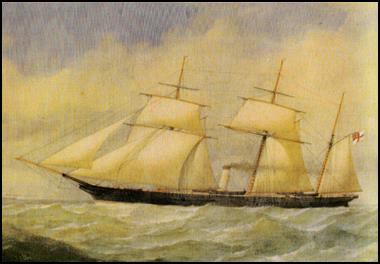
Her Majesty's Colonial Steam Sloop Victoria was built in the Limehouse
yard of Young, Son & Magnay and was the first vessel of war to be built to
the order of any British Colony (seen on the right). She was of 580 tons, cost £38,000 and was
launched by Lady Constance Talbot on June 30th
1855, but was delayed from leaving Portsmouth until March 1856 by a
lawsuit concerning the patents on her propeller. By this time Hotham had died. Commander Norman had stood by her while she
was on the stocks and brought her out to Victoria, reaching Williamstown on 31st
May 1856.
On his return he was
appointed to Queen of the South belonging to the same company. Among the passengers on this steam auxiliary
ship's trip to Victoria was Sir Charles Hotham K.C.B. and his wife and retinue. He was about to be appointed as Victoria's
Lieutenant Governor. Sir Charles was
acknowledged to be one of the ablest officers in Her Majesty's Royal Navy,
having been posted as captain in 1832 at the age of 26. He was much struck with the character of
Captain Norman and endeavoured to secure his services for the new colony of
Victoria. The Crimean War with Russia
was raging, and because of the perceived threat of invasion of this new colony
of Victoria, the Victorian Government commissioned the construction of an armed
steam sloop, whose specifications were drawn up by one of the most skilled
naval architects of the time, Oliver Lang.
Her Majesty's Colonial Steam Sloop Victoria was built in the Limehouse
yard of Young, Son & Magnay and was the first vessel of war to be built to
the order of any British Colony (seen on the right). She was of 580 tons, cost £38,000 and was
launched by Lady Constance Talbot on June 30th
1855, but was delayed from leaving Portsmouth until March 1856 by a
lawsuit concerning the patents on her propeller. By this time Hotham had died. Commander Norman had stood by her while she
was on the stocks and brought her out to Victoria, reaching Williamstown on 31st
May 1856.
His
new wife and three young children accompanied him, but
left behind his elder son Thomas William by his first wife Sarah to the care of
her relatives. His wife gave birth to
their third son George Harold at Williamstown on October 6th 1856. At that time
their other children, all born in England, were Mary, 5 years. Henry, 3 years and Ernest aged 1 year.
Norman and HMCSS
Victoria were soon busy in Victorian waters. Commencing official duties on June 6th 1856, they assisted Arthur the Great, which had grounded
off Point Wilson and after three days hard work succeeded in re-floating
her. They next helped the West Channel
Lightship
which had broken away from its moorings, and in early July they went to the aid
of Moorsfoot,
aground at the Heads. Later that month
the Lawrence
Frost required assistance after running ashore and the wreck of the
brig Mountain
Maid had to be moved from the channel after it sank in a
collision. When there was an uprising
among prisoners on the penal hulk Lysander on 22nd October
1856, the Victoria's boats were manned with armed men and sent to assist.
The Victoria also undertook
much water police work and so after some political manoeuvring the Victorian
Government brought about the appointment of Captain Norman and his crew to the
Water Police on 1st January 1858.
However the expense of this arrangement was
soon seen to be disproportionate to the Water Police budget and the ship and
crew reverted to being under the orders of the Chief Harbour Master and the
Government in 1859.
 Apart from giving
assistance to shipwrecked vessels and mariners, there were regular duties such
as collecting overseas mail from steamers at the Heads, carrying out coastal
and hydrographical survey works and taking inspection parties and stores to
lighthouses and outposts.
Apart from giving
assistance to shipwrecked vessels and mariners, there were regular duties such
as collecting overseas mail from steamers at the Heads, carrying out coastal
and hydrographical survey works and taking inspection parties and stores to
lighthouses and outposts.
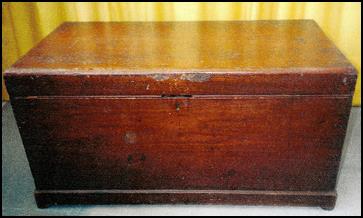
Captain Norman's sea chest
In 1857 and 1858, Victoria
did some useful work in conducting the surveys preliminary to the laying of the
submarine cable to Tasmania. Immediately
after this, when stories of starvation and distress of would-be miners who had
travelled to goldfields near Rockhampton, Queensland, reached Melbourne, the Victoria
was sent north with provisions. She
called at Sydney and on the 30th October
1858 was honoured by a visit of inspection from the Governor-General, which
would lead us to believe that this was, in fact, her first visit to
Sydney. On proceeding to Port Curtis,
Norman found the stories of distress were greatly exaggerated and brought most
of the stores home again, although he was able to assist in the repatriation of
many of the disappointed diggers. 2,000
were enabled to return to their homes in Victoria, thanks to the arrangements
made by the Government Resident at Gladstone. Norman also provided passage back to Sydney
for 90 unsuccessful prospectors for whom other transport could not be found,
their disillusionment being completed by the very rough seas encountered as
they left Keppel Bay. A week of
refitting in Sydney was necessary for the Victoria, which eventually arrived
back in Melbourne on December 7th.
Early in 1860 Captain
Norman and his crew took part in the procession to lay a foundation stone in
Williamstown's Mechanic's Institute, with Norman, who declined to share marshal
duties for the procession with Louis La Roche, stating his strong-held
principle that a divided command is no command at all and the single person in
charge should receive all the honour or blame, depending on how things turned
out. In this case, La Roche received the
accolade, but a collection of Testimonials to Norman shows his stature in
command.
From April 1860 for nearly
a year, HMCSS Victoria was on loan to the New Zealand Government to assist in
the Taranki uprising and expressions of appreciation of the "zeal and
activity worthy of the highest commendation" and "invaluable
services"[2]
were received by the Victorian Government.
By the time HMCSS Victoria
returned to Melbourne, great concern was being expressed for Burke and Wills
and their "Overland Exploring Expedition", which had left Melbourne on
the 20th August 1860. Two relief efforts were mounted, Howitt
departing across country in July 1861 and Norman and his crew setting out on August
4th. Norman's journal tells
graphically of their weathering a cyclone in which the accompanying vessel Firefly
was lost and wrecked, but fortunately found again and repaired. He describes collecting turtles to make up
for lost stores, and rowing up the rivers and creeks
by moonlight to take full advantage of the tides. References made in his journal to the sufferings
endured from heat, mosquitoes, boils and other forms
of sickness show that it was no pleasure trip for either him or his crew. Whilst in the area he discovered a coral reef
not previously charted, in the inner passage of the Torres Straits, and made a
careful examination of the Chilcott Rocks in the same vicinity. When this information was communicated to the
Lords Commissioners of the Admiralty in London, their response was "Their
Lordships are also desirous that you convey to Captain Norman their thanks for
the zeal he has shown in so carefully examining and describing these
reefs." It was not until the 31st March 1862 that they arrived home in
Williamstown. An Illuminated Address was
presented in public in St George's Hall, Melbourne, by His Excellency the
Governor Sir Henry Barkly to Commander Norman and the Officers of Her Majesty's
Colonial Steam Ship Victoria. It was signed
by William F. Stawell, chairman of the Exploration Committee of the Royal
Society of Victoria and dated Melbourne June 8th
1862.
Norman's original period
of contract finished in July 1864 and on the 31st
August the Victoria was paid out of commission and almost all hands were
discharged. However
a few were retained for the purpose of looking after the ship and her engines but
her Naval Service had then ceased.
Despite this, Captain Norman retained command and his vessel continued
to perform occasional services quite unconnected with Marine surveying to which
the Government had intended she be attached.
In October 1865 she was sent by the Commissioner of Trade and Customs to
search for castaways on the Auckland Islands, south of New Zealand. Captain Thomas Musgrave, who had been wrecked
there in the Grafton in January 1864, accompanied them, since he knew the
area so well.
They spent three weeks
releasing livestock and planting food-bearing plants and trees on the Islands
before refitting at Port Chalmers and reaching Melbourne at the end of
November. In 1866 they collected
survivors form the wreck of the Netherby from King Island. On January 4th
1868, Captain Norman accompanied His Royal Highness Prince Alfred and
the Governor of Victoria at the laying of the memorial stone of the Alfred Graving
Dock at Williamstown. The Prince was conveyed in the barge of HMCSS Victoria
to his vessel, the steam corvette Galatea, with HMCSS Victoria
firing a salute "with admirable rapidity and regularity" as the barge
passed by. HMCS Victoria then accompanied
the Galatea
down the Bay and fired another royal salute as they parted.
 In the 1860s it was decided to introduce Atlantic salmon and trout from
the British Isles to the waters of Tasmania and the Tasmanian Salmon
Commissioners commenced the project.
When, on the fourth attempt, the trout and salmon ova arrived by the clipper
ship Norfolk in a deck ice-house in good condition,
the manager of the project, Mr Ovisbottom, "placed them all safely on the
Victoria, then sailed off to Hobart Town, slick - con amore" - so wrote
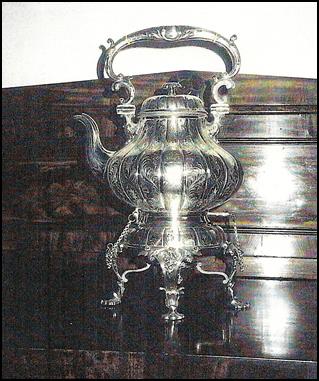
'Barrie Couta' in his epic poem of "Salmoniana" in 1866. Captain Norman was presented with a silver
tray and a silver hot water kettle on a stand on this occasion, shown in the
picture on the preceding page. The
inscription on the tea kettle reads "Presented by the Commissioners,
appointed by the Governor of Tasmania to conduct the experiment of introducing
salmon into the rivers of that Colony. To Captain W. H. Norman of HMCSS Victoria
as a token of their appreciation of the services which, as Commander of the
vessel, he rendered to the undertaking 8th June 1866"
In the 1860s it was decided to introduce Atlantic salmon and trout from
the British Isles to the waters of Tasmania and the Tasmanian Salmon
Commissioners commenced the project.
When, on the fourth attempt, the trout and salmon ova arrived by the clipper
ship Norfolk in a deck ice-house in good condition,
the manager of the project, Mr Ovisbottom, "placed them all safely on the
Victoria, then sailed off to Hobart Town, slick - con amore" - so wrote
'Barrie Couta' in his epic poem of "Salmoniana" in 1866. Captain Norman was presented with a silver
tray and a silver hot water kettle on a stand on this occasion, shown in the
picture on the preceding page. The
inscription on the tea kettle reads "Presented by the Commissioners,
appointed by the Governor of Tasmania to conduct the experiment of introducing
salmon into the rivers of that Colony. To Captain W. H. Norman of HMCSS Victoria
as a token of their appreciation of the services which, as Commander of the
vessel, he rendered to the undertaking 8th June 1866"
By 1866 William Henry and
Mary Jane had 9 children, as well as William's eldest son from England, William
Thomas, who arrived at Williamstown in 1857, aged 18 years and commenced a
successful career with the Bank of Australasia.
Four years later William Thomas was made executor of his father's
will. The nine children by Mary Jane and
were Mary 14 (1852), Henry 13 (1853), Charles 11 (1854) all born in England,
George Harold 10 (1856), Ann Eliza 8 (1858), Eva Louisa been born in 1860, but died in 1863, Victoria
4 (1862), Edgar 3 (1863), and Katherine Florence born that year (1866). The last six were all born in Williamstown,
Victoria. They all lived in
Williamstown, Melbourne's port. To begin
with they were granted a Government house and the boys
attended Williamstown Grammar School and later Scotch College. Later, however, Captain Norman invested in
real estate in and around Williamstown and provided residences for his large
family in the most attractive parts of the town. In 1858 he moved his family into a spacious seven bedroom dwelling in Nelson Place, which overlooked the
picturesque Hobson's Bay. He later built
a grand two storey house for his family, called at that time "Abberton
House" at 24 The Strand, with wide views across Hobson's Bay across to the
city of Melbourne.
Captain Norman was always
regarded as one of the ablest seamen who ever entered the port of Melbourne and
between him and those who served with him there always existed the warmest
feelings of regard. In his last years in
Victoria he was concerned by an idea that he should be
turned adrift by the Government which he served so well. His concern was mainly because he had so
numerous and young family to support.
His hope was to take on the position of Chief Harbour Master, for which
post he was pre-eminently qualified, but which was not vacant at the time - and
he felt unable to accept the only alternative offer - that of a Water Police Magistrate.
When, however, Commander
Norman was appointed to be sent to England to supervise the building of the
iron-clad ship Cerebus he was gratified, being also led to believe that he
might obtain the desired post of Harbour Master on his return to
Melbourne. On arriving in England he found a vessel, the design of which he considered
unseaworthy, and the story has been handed down through the generations that
the strain of trying to combat political pressures and getting the best result
for the Victorian Colonial Government.
Eventually his health broke down and he went to stay with his sister and
family in Ramsgate, hoping to recover enough to carry on his work.
Unfortunately
his health continued to decline and he was diagnosed with hepatic and cardiac
disease (liver & heart), which his body, worn out with 45 years at sea,
could not overcome. His last four months
were spent at 2 Royal Crescent, Ramsgate in the company of his younger sister
Jane and her family and his long-time friend, the imposing and highly regarded
Sir George Verdon, Agent-General for Victoria.[3] William Henry Norman died on the 12th December 1869, aged just 57. He was survived by his wife, Mary Jane and
her eight living children as well as his eldest son by Mary Stretch.
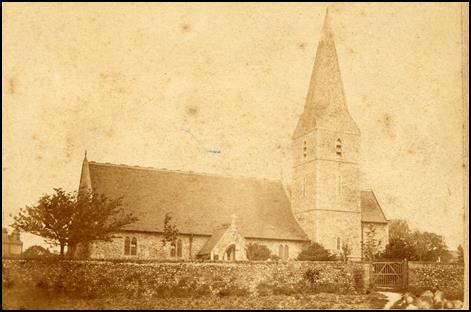 He was buried in All
Saints Birchington churchyard on the north side of the ground, beside the
boundary wall. The choice of this place
was because his father, who had spent many years in Dover, came to live in
Birchington not long before he died. For
this reason he had been buried in All Saints
churchyard, but without a gravestone.
The Verger would have noted where the Thomas's grave was, so when
William Henry needed a grave, the same site was chosen.
He was buried in All
Saints Birchington churchyard on the north side of the ground, beside the
boundary wall. The choice of this place
was because his father, who had spent many years in Dover, came to live in
Birchington not long before he died. For
this reason he had been buried in All Saints
churchyard, but without a gravestone.
The Verger would have noted where the Thomas's grave was, so when
William Henry needed a grave, the same site was chosen.
All Saints Church, Birchington as it stood in 1869.
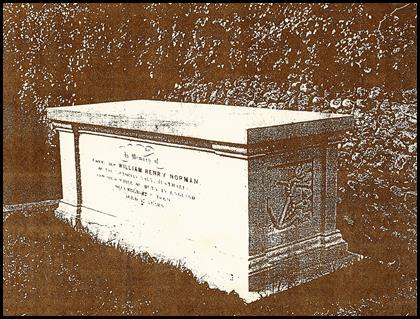 The tomb was an imposing altar tomb with the following inscription
engraved on it - "In memory of Commander William Henry NORMAN of the Victoria Navy,
Australia, who died while on duty in England, 12 Dec 1869 aged 57 years"
The tomb was an imposing altar tomb with the following inscription
engraved on it - "In memory of Commander William Henry NORMAN of the Victoria Navy,
Australia, who died while on duty in England, 12 Dec 1869 aged 57 years"
Commander Norman's grave in All Saints Churchyard,
Birchington as it looked in
1870. It stands on the
North side abutting the wall near the Powell Arms
On one of the end panels these additional words to commemorate his
father were added - "In memory of Thomas NORMAN, later of Dover
and Birchington, who died 27 Jun 1858 aged 87"
1999
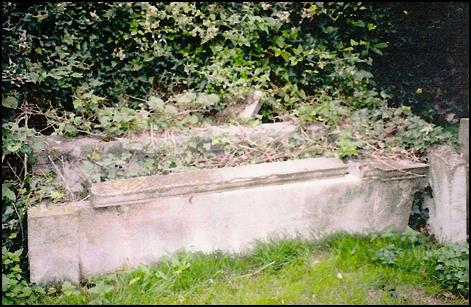
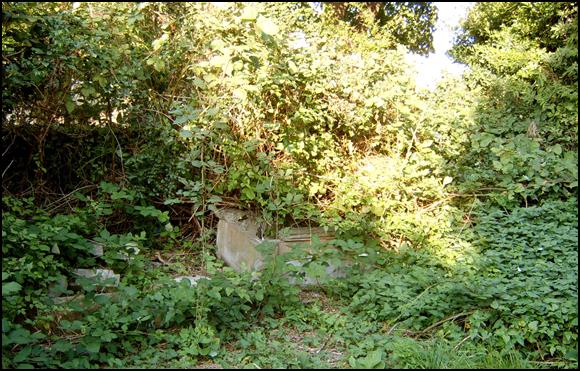 This photograph of the
grave taken in 1999 shows it was in very poor condition by then. Unfortunately, in the last 9 years since
then, it has deteriorated even more and when John Edwards, a descendent from
Australia, came on the 17th September this
year 2008, it looked even worse than the photo below. John could not even see the stone when he
first got there but after an hour's work he had cleared
a lot of brambles etc. around it and the broken pieces of stone re-appeared.
This photograph of the
grave taken in 1999 shows it was in very poor condition by then. Unfortunately, in the last 9 years since
then, it has deteriorated even more and when John Edwards, a descendent from
Australia, came on the 17th September this
year 2008, it looked even worse than the photo below. John could not even see the stone when he
first got there but after an hour's work he had cleared
a lot of brambles etc. around it and the broken pieces of stone re-appeared.
2008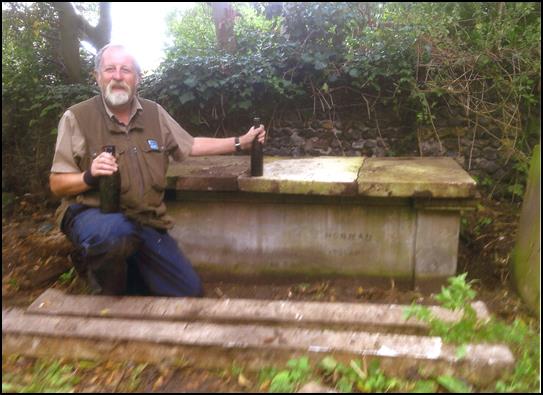
It is sadly in need of
repair and the rest of the undergrowth around it needs to be cleared. The church is no longer able to afford to
keep a Verger and graveyard attendant, so the job of keeping the area tidy is
left to Thanet Council who simply mow the grass in the open areas on the south
and eastern ends of the churchyard. Any
other work that is undertaken is done by volunteers in what little spare time
they can give.
Norman grave + restorer (Terry) Oct 2015